If your Georgia property tax bill keeps climbing, there may be a way to stop the increases for three full years. The state's 299c freeze locks your assessed value after a successful appeal, shielding you from rising county valuations while you keep your home.
Below, we break down how the freeze works, who qualifies, and how to make it worth as much as possible.
Key Takeaways
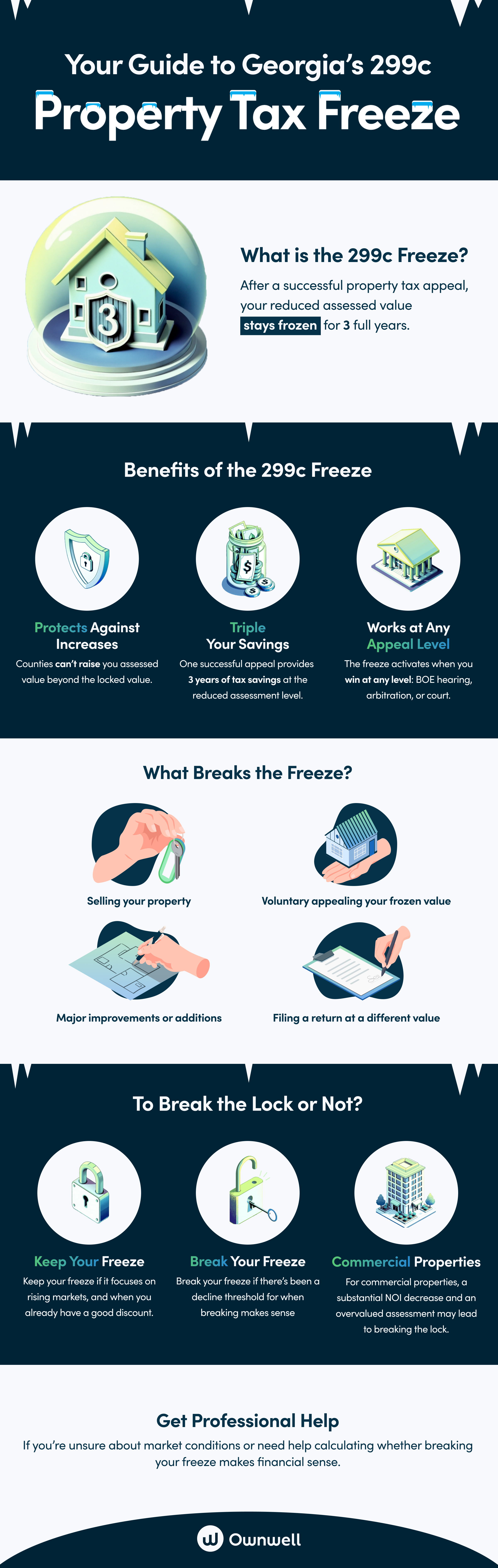
Three-year value lock: Georgia's 299c freeze (O.C.G.A. § 48-5-299(c)) locks your property's assessed value for the appeal year plus the two following tax years after a successful appeal.
A formal appeal is often needed: The freeze takes effect only after an appeal is resolved by the Board of Assessors (BOA), the Board of Equalization (BOE), a hearing officer, an arbitrator, or the Superior Court. Informal 30-day settlements with the county assessor may not trigger it.
Only the assessed value is frozen: In Georgia, the assessed value equals 40% of the appraised fair market value. Your millage rate is set annually and can still change your tax bill.
Four ways to break it: The freeze ends if the property is sold, substantial improvements are made, you file a new appeal, or you file a tax return at a different valuation.
Risk of a failed appeal: Georgia is one of the few states where a failed or poorly supported appeal can actually increase your assessed value. Professional representation helps protect against this outcome.
Strategic re-appeal: If market values drop below your frozen value, breaking the freeze to re-appeal may yield greater savings than keeping it.
What Is Georgia's 299c Property Tax Freeze?
A property tax freeze prevents the county from raising your property's taxable value for a set period. In Georgia, the 299c freeze — formally O.C.G.A. § 48-5-299(c) — locks your assessed value for three years following a successful property tax appeal.
In Georgia, assessed value equals 40% of the appraised fair market value set by your county's Tax Assessor. The freeze prevents the assessor from increasing that value during the freeze period, even if the local market heats up.
The freeze applies to the appeal year plus the next two tax years. During that window, the county cannot raise your assessment — though your tax bill can still shift if local millage rates change.
Note that, following the passage of House Bill 581 (effective for the 2025/2026 tax cycles), Georgia law now limits the 299c freeze to properties that experience an actual value reduction. If the BOA, BOE, an arbitrator, or a court leaves your valuation unchanged or rules against you, no freeze is applied.
How the 299c Freeze Works: Example Calculation
The real power of the 299c freeze shows up over time. While your assessed value stays locked, the county could otherwise change it each year to reflect rising market values. The longer you hold the freeze, the wider the gap between what you pay and what the county wants to charge in a hot market.
Consider a Georgia home with a fair market value of $500,000 and a local millage rate of 30 mills. After a successful appeal, the county agrees to a fair market value (FMV) of $500,000.
Year | Without Appeal (FMV) | Without Appeal (Assessed at 40%) | Without Appeal (Tax at 30 Mills) | With 299c Freeze and $10k reduction (Assessed at 40%) | With 299c Freeze (Tax at 30 Mills) | Annual Savings |
Year 1 | $500,000 | $200,000 | $6,000 | $190,000 | $5,700 | $300 |
Year 2 | $530,000 (assumed +6%) | $212,000 | $6,360 | $190,000 | $5,700 | $660 |
Year 3 | $562,000 (assumed +6%) | $224,800 | $6,744 | $190,000 | $5,700 | $1,044 |
Note: This table assumes a constant millage rate and 6% FMV increase for simplicity. Your actual tax bill may vary as local governments adjust rates annually and as market conditions shift.
Without the freeze, the county raises your assessed value each year to reflect appreciation. With the freeze, your assessed value stays at $190,000 for all three years. The savings grow each year as the gap widens.
Fulton County homeowners and those in other fast-appreciating Georgia markets often see even larger gaps. Ownwell customers save an average of $774 per year on their property taxes, and the 299c freeze can extend those reductions across three full tax years.
Find out in 60 seconds if you're overpaying on your Georgia property taxes.
How to Obtain the 299c Freeze in Georgia
The freeze is not automatic from the start — but once you win a formal appeal, the law triggers it without additional paperwork. Here is the four-step process.
1. File a Timely Appeal
You have 45 days from the date on your assessment notice to file a property tax appeal with your county Board of Assessors. Missing this deadline forfeits your right to appeal for that tax year.
2. Proceed to a Formal Resolution
Your appeal must be resolved through a formal channel: the Board of Equalization (BOE), a hearing officer, an arbitrator, or Superior Court. This is the most critical step.
An informal settlement with the county assessor's office may reduce your value, but most 299c freezes will activate at the BOE level. After managing thousands of Georgia appeals, we have found that ensuring a formal BOE resolution is the single most important step for securing the three-year lock.
3. Attend the Hearing
Someone must appear at the hearing on your behalf, usually the property owner or an authorized representative such as Ownwell. Bring comparable sales data, property photos, and any evidence of condition issues that support a lower valuation.
4. Confirm 299c Language in the Written Decision
After a successful appeal, verify that the final written decision explicitly references the 299c freeze. This documentation confirms your assessed value is locked for the next two tax years as well. Again, you must experience an actual value reduction to qualify for the 299c freeze.
What Can Break the 299c Freeze?
Four events can void the freeze before the three-year period ends:
Substantial improvements: Major renovations or additions that materially increase your property's value, such as adding square footage or a pool. Routine maintenance does not count.
Selling the property: The freeze terminates automatically upon transfer of ownership.
Filing a new appeal: If you voluntarily appeal again, you break the lock. Only do this if market values have dropped well below your frozen assessment.
Filing a tax return at a different valuation: Reporting a different value on a property tax return during the freeze period can void the protection.
What Does Not Break the Freeze
Several common changes have no effect on your frozen value:
General market appreciation in your neighborhood
Neighboring properties are selling at higher prices
County-wide reassessments or property value changes affecting other homeowners (unless there is a major market downturn, we don't recommend reappealing while you have the freeze)
Increases or decreases to local millage rates
Changes to your statewide or floating homestead exemption amount
Your assessed value remains locked regardless of what happens to the broader market around you.
How to Maximize Your 299c Freeze
Winning an appeal is step one. Making the freeze as valuable as possible takes a bit more planning.
Appeal aggressively for the lowest possible value: Every dollar reduction is multiplied across three tax years. A $10,000 drop in assessed value at a 30-mill rate saves you $300 per year — $900 over the life of the freeze.
Ensure a formal BOE resolution: 30-day settlements with the assessor may lower your bill for one year, but may not trigger the three-year lock. Insist on a BOA and then a formal hearing with the BOE if the freeze matters to you.
Time improvements carefully: File your appeal before starting major renovations. Substantial improvements made during the freeze period can void your protection.
Use a professional representative: Experienced representatives often achieve larger reductions, and with the three-year multiplier, the investment in professional help typically pays for itself.
Plan your next appeal for Year 3: Mark your calendar. When the freeze expires, the county reassesses at the current market value. Filing a new appeal immediately can lock in another three-year freeze!
How Much Are You Over Paying?
Commercial Property and the 299c Freeze
Commercial property tax appeals in Georgia typically involve more sophisticated valuation methodologies, including income capitalization approaches and detailed market analyses. However, the fundamental process for securing the 299c freeze remains the same.
Owners of office buildings, retail centers, and Atlanta multifamily properties can all benefit from the three-year lock.
Example: Commercial property with an initial frozen FMV of $2,500,000 (25 mill rate)
Scenario | Declining Market Value | Frozen Assessed Value (40%) | New Assessed Value | Annual Tax Savings |
Current Freeze | $2,500,000 | $1,000,000 | $1,000,000 | $0 |
5% Decline | $2,375,000 | $1,000,000 | $950,000 | $1,250 |
10% Decline | $2,250,000 | $1,000,000 | $900,000 | $2,500 |
20% Decline | $2,000,000 | $1,000,000 | $800,000 | $5,000 |
Should You Break Your 299c Freeze and Re-Appeal?
Determining whether to relinquish a 299c property tax freeze and risk re-appealing hinges on a careful analysis of current market values relative to the frozen assessment to maximize potential tax savings.
The Core Dilemma: Weighing Stability vs. Potential Savings
The 299c freeze provides predictability and protection against rising assessed values, especially in dynamic markets, by locking in an assessed value for three years.
However, if market values fall below the current frozen assessed value, maintaining the freeze would mean paying taxes on an inflated valuation.
When to Maintain Your 299c Freeze
Keep your frozen assessed value if:
Property values are rising: In an appreciating market, your frozen assessment becomes increasingly valuable.
Your freeze discount is substantial: If your frozen value is roughly 20% or more below current market assessments.
You plan to hold the property: Long-term owners benefit most from the freeze.
Market indicators suggest continued growth: Current real estate forecasts show continued appreciation.
When to Consider Giving Up Your Freeze
Consider appealing again (and potentially losing your freeze) if:
Significant market downturn:
Your property's actual value has dropped well below your frozen assessment.
The math supports it: Calculate the potential savings:
Current frozen assessed value × millage rate = current tax bill
Potential new assessed value × millage rate = potential tax bill
If the difference exceeds the risk of future increases, consider appealing.
The decision depends on your specific frozen value, the current market value, and the applicable millage rate. There is no single fixed percentage that works for every homeowner. Reviewing data for your county — such as DeKalb County or Cobb County property values — can help you make an informed choice. You can also track assessment trends across the state on Georgia property tax trends.
Keep in mind that Georgia is one of the few states where a failed or poorly supported appeal can actually increase your assessed value. This is why Ownwell reviews your property's market data before filing to ensure an appeal is likely to succeed.
How Ownwell Can Help
The 299c freeze locks your assessed value for three full years, and Ownwell is built to help you secure it. We handle the entire appeal process so you can lock in savings without navigating the system yourself.
88% success rate across all appeals filed
$774 average annual savings for Ownwell customers
4.7-star rating across 3,000+ Google reviews
35% contingency fee — you only pay if we reduce your tax bill
An additional $20 fee when the 299c freeze is secured on your property
Our end-to-end service covers every step: submission, AI-powered market analysis, paperwork, evidence preparation, hearing representation, and outcome tracking. Our local consultants know the appraisers, boards, and hearing officers in Georgia's major counties.
Because Georgia allows assessors to raise values after a failed appeal, we review your property's market data before filing to confirm an appeal is likely to succeed. We use tools like our Fulton County property data reports to build the strongest possible case.
Want to Try What Made Ownwell Famous?
Frequently Asked Questions
How Long Does the 299c Freeze Last?
Three tax years: the year of the successful appeal plus the two following years.
Does the 299c Freeze Apply to Commercial Properties?
Yes. The 299c freeze applies to both residential and commercial properties in Georgia.
Is the Millage Rate Frozen Too?
No. Only the assessed value is locked. Local governments can still change millage rates annually, so your tax bill may still change even during the freeze.
Is the 299c Freeze Automatic?
The freeze is usually triggered by law after a successful appeal resolved by the Board of Equalization, a hearing officer, an arbitrator, or the Superior Court. You do not need to file additional paperwork. However, informal settlements with the county assessor may not activate it — a formal hearing is the surest path.
What Happens When the 299c Freeze Expires?
After three years, the county reassesses your property at the current market value. If values have risen during that time, your assessment could jump significantly. Filing a new appeal immediately gives you the chance to lock in another three-year freeze and manage your Georgia homestead exemption alongside your assessment.
See how much you could save — and lock it in for three years. Check your property's savings estimate with no upfront cost. You pay a 35% contingency fee only if Ownwell reduces your tax bill.